
Abdul Satar KAWA*
Abstract
Afghanistan has experienced prolonged political instability, foreign intervention, armed conflict, and internal power struggles throughout its modern history. Against this background, the Taliban emerged in southern Afghanistan in the 1990s and rapidly expanded its control, eventually taking power in 1996. During its first period of rule, the Taliban introduced a strict interpretation of Islamic law and imposed severe restrictions on fundamental rights and freedoms, particularly those of women and girls. Following the September 11, 2001 attacks, the United States and its allies intervened in Afghanistan, leading to the collapse of the Taliban government. Nevertheless, the Taliban continued its armed struggle against Afghan and international forces for the following two decades. The failure to achieve a decisive military outcome ultimately contributed to negotiations between the United States and the Taliban, culminating in the Doha Agreement of February 2020 and the subsequent withdrawal of U.S. forces. On August 15, 2021, the Taliban regained control of Kabul and once again became the dominant political authority in Afghanistan. This article examines the historical emergence and development of the Taliban, the main factors that facilitated its return to power, and the political and social consequences of the 2021 takeover. Particular attention is given to restrictions on women’s and girls’ rights, education, freedom of expression and the media, political repression, international isolation, and migration. The article argues that despite the Taliban’s pre-takeover promises of a more inclusive and moderate system of governance, its policies after returning to power reproduced many of the restrictive practices associated with its first period of rule.
Keywords: Afghanistan, Taliban, 2021 Taliban Takeover, Human Rights, Women’s Rights, Doha Agreement, Migration
Introduction
Afghanistan occupies a strategically important geographical position connecting Central Asia, South Asia, and the Middle East. Throughout its modern history, the country has been affected by competition among major powers, foreign interventions, domestic political struggles, and prolonged armed conflicts. These historical dynamics have significantly influenced Afghanistan’s political, economic, and social development (Barfield, 2010).
The Soviet intervention in Afghanistan in 1979 represented one of the most significant turning points in the country’s contemporary history. The intervention contributed to the mobilization of various resistance movements, generally known as the Mujahideen, which fought against Soviet forces and the Soviet-backed Afghan government. Following the Soviet withdrawal in 1989 and the collapse of the communist government in Kabul in 1992, conflicts among the Mujahideen factions resulted in a devastating civil war. Political fragmentation, insecurity, and the growing influence of regional warlords subsequently created conditions that facilitated the emergence of the Taliban in southern Afghanistan (Barfield, 2010; Rashid, 2000).
The Taliban first gained control of Kabul in 1996 and established a political system characterized by a highly restrictive interpretation of Islamic law. Its rule was particularly consequential for women and girls, whose access to education, employment, and public life was severely restricted. Following the September 11, 2001 attacks, the U.S.-led military intervention resulted in the collapse of the Taliban government. However, the movement survived and gradually reorganized as an insurgency against the Afghan government and international forces (Giustozzi, 2007).
Twenty years later, the withdrawal of U.S. and international forces and the rapid collapse of the Afghan government enabled the Taliban to regain control of Kabul on August 15, 2021. This article therefore examines the historical emergence of the Taliban, the circumstances surrounding its rise to power, the factors contributing to its return in 2021, and the political and social consequences of its second period of rule.
The Emergence of the Taliban
Since the eighteenth century, Afghanistan has been situated within the spheres of influence and strategic competition of major powers, particularly Britain, the Soviet Union, and later the United States. Foreign interventions and domestic conflicts generated significant political, social, economic, and security challenges for the country (Barfield, 2010). In particular, the Soviet intervention in 1979 severely disrupted Afghanistan’s political and social order and contributed to the mobilization of resistance movements that became collectively known as the Mujahideen.
The Soviet withdrawal from Afghanistan in 1989 was followed by the collapse of the Soviet-backed communist government in Kabul in 1992. Following the collapse of the government, Mujahideen groups that had fought against Soviet forces established a new political administration. Sibghatullah Mujaddidi briefly served as president during the transitional period. However, the Mujahideen factions that had previously fought against a common enemy were unable to agree on the distribution of political power and subsequently entered into armed conflict with one another. The resulting civil war devastated Kabul and other parts of Afghanistan, weakened central authority, and allowed different commanders and warlords to establish control over various regions (Rashid, 2000).
It was within this environment of political fragmentation and insecurity that the Taliban emerged under the leadership of Mullah Mohammad Omar in Kandahar in southern Afghanistan. Taking advantage of widespread dissatisfaction with the Mujahideen factions and the absence of effective central authority, the Taliban rapidly expanded its territorial control. By the late 1990s, it controlled most of Afghanistan. Initially, some Afghans viewed the movement as a force capable of restoring security, disarming warlords, and ending years of civil conflict. However, its subsequent policies created an extremely restrictive political and social environment (Rashid, 2000).
The term Taliban is related to the word talib, meaning “student,” reflecting the religious educational background of many of the movement’s early members. A significant number of early Taliban members had studied in religious schools or madrasas, particularly in Afghanistan and Pakistan (Ahmadi, 2017).
During its first period of rule, the Taliban imposed severe restrictions on the Afghan population, particularly women and girls. Girls were largely prevented from attending school, women were excluded from most forms of employment outside the home, and numerous restrictions were imposed on cultural activities and everyday social life. Television, music, photography, and various forms of entertainment were restricted or prohibited, while strict dress and behavioral regulations were imposed on both men and women (Rashid, 2000).
Pakistan also played an important role in the political environment surrounding the Taliban’s rise. Afghanistan-Pakistan relations had historically been complicated by disputes over the Durand Line and the Pashtunistan question. Pakistan’s strategic concerns regarding India and its desire to maintain political influence in Afghanistan were also important elements of its Afghan policy. Pakistan consequently viewed the Taliban as a political actor capable of providing strategic advantages in Afghanistan (Dashti, 2021).
Pakistan also had economic interests connected to political stability in Afghanistan. Greater stability could potentially facilitate transportation and energy projects linking Central Asia to South Asia. Proposed pipelines originating in energy-rich Central Asian states, including Turkmenistan, and passing through Afghanistan were viewed as potentially important for Pakistan’s access to regional energy resources and trade routes (Kuğu, 2020).
The Taliban, Al-Qaeda, and the Post-2001 Conflict
The Taliban’s capture of most of Afghanistan did not end armed conflict in the country. The Northern Alliance, composed primarily of Tajik, Uzbek, and Hazara forces and including other anti-Taliban groups, continued to resist Taliban rule, particularly in northern Afghanistan. One of its most prominent leaders was Ahmad Shah Massoud. On September 9, 2001, two days before the September 11 attacks in the United States, Massoud was assassinated by attackers posing as journalists. The assassination was linked to Al-Qaeda (Karakoç-Dora, 2021).
The September 11, 2001 attacks fundamentally transformed Afghanistan’s political situation. Al-Qaeda leader Osama bin Laden was based in Afghanistan under Taliban rule, and the United States demanded that the Taliban hand him over and dismantle Al-Qaeda’s presence in the country. Following the Taliban’s refusal to meet U.S. demands, the United States and its allies launched military operations in Afghanistan in October 2001. The Taliban government was rapidly overthrown, and a new political order supported by the international community was subsequently established.
However, the collapse of the Taliban government did not result in the disappearance of the movement. Taliban members gradually reorganized and developed an insurgency against Afghan government forces and the international military presence. Over the following years, the movement established networks and structures that enabled it to maintain operations across significant parts of Afghanistan (Giustozzi, 2007).
Despite approximately two decades of military operations, neither the Afghan government nor its international partners succeeded in decisively defeating the Taliban. As the conflict continued, negotiations increasingly emerged as an alternative to a purely military solution.
The Doha Agreement and the Taliban’s Return to Power
Negotiations between the United States and the Taliban intensified during the administration of U.S. President Donald Trump. Zalmay Khalilzad served as the U.S. Special Representative for Afghanistan Reconciliation and led negotiations with Taliban representatives. These negotiations ultimately resulted in the signing of the Agreement for Bringing Peace to Afghanistan in Doha on February 29, 2020 (U.S. Department of State, 2020).
Under the agreement, the Taliban committed to preventing individuals and groups, including Al-Qaeda, from using Afghan territory to threaten the security of the United States and its allies. In return, the agreement established a timetable for the withdrawal of U.S. and coalition forces from Afghanistan (U.S. Department of State, 2020).
While negotiations continued, however, fighting between the Taliban and Afghan government forces remained intense. The withdrawal of international forces during 2021 fundamentally changed the balance of power. The Taliban rapidly captured provincial capitals and other major cities as Afghan government forces collapsed or surrendered in many parts of the country.
On August 15, 2021, Taliban forces entered Kabul as President Ashraf Ghani left Afghanistan. The rapid collapse of the Afghan government brought an end to the political order established after 2001 and returned the Taliban to power twenty years after its first government had been overthrown.
What Happened in Afghanistan After the Taliban Came to Power?
Before capturing Kabul, Taliban representatives repeatedly attempted to present the movement as different from the organization that had governed Afghanistan between 1996 and 2001. During negotiations and public statements, Taliban representatives indicated that they would respect certain fundamental rights, establish a more inclusive government, and protect women’s rights within their interpretation of Islamic principles.
However, developments following August 2021 created significant doubts regarding these commitments. Restrictions affecting women, girls, journalists, former government officials, human rights defenders, and other groups were progressively introduced. UNAMA subsequently documented violations involving extrajudicial killings, arbitrary detention, torture and ill-treatment, restrictions on fundamental freedoms, and violations affecting women and girls (United Nations Assistance Mission in Afghanistan [UNAMA], 2022a).
Shortly after taking control of Kabul, the Taliban announced a nationwide general amnesty covering individuals who had worked for the former Afghan government, security forces, and international organizations. However, evidence collected by UNAMA indicated that the amnesty was not consistently respected. Between August 15, 2021, and June 15, 2022, UNAMA documented at least 160 extrajudicial killings of former Afghan government and security officials attributed to members of the de facto authorities (UNAMA, 2022a).
Resistance to Taliban rule also emerged in Panjshir under the leadership of Ahmad Massoud, the son of Ahmad Shah Massoud. Fighting between Taliban forces and the National Resistance Front generated additional allegations of human rights violations. UNAMA documented extrajudicial killings, arbitrary arrests and detentions, and cases of torture and ill-treatment involving individuals accused of affiliation with the National Resistance Front (UNAMA, 2022a).
Media and Freedom of Expression
Freedom of expression and media freedom also became major areas of concern following the Taliban takeover. Taliban authorities introduced broad restrictions on journalists and media organizations, while journalists were subjected to detention, intimidation, physical abuse, and pressure regarding their reporting (Human Rights Watch, 2021).
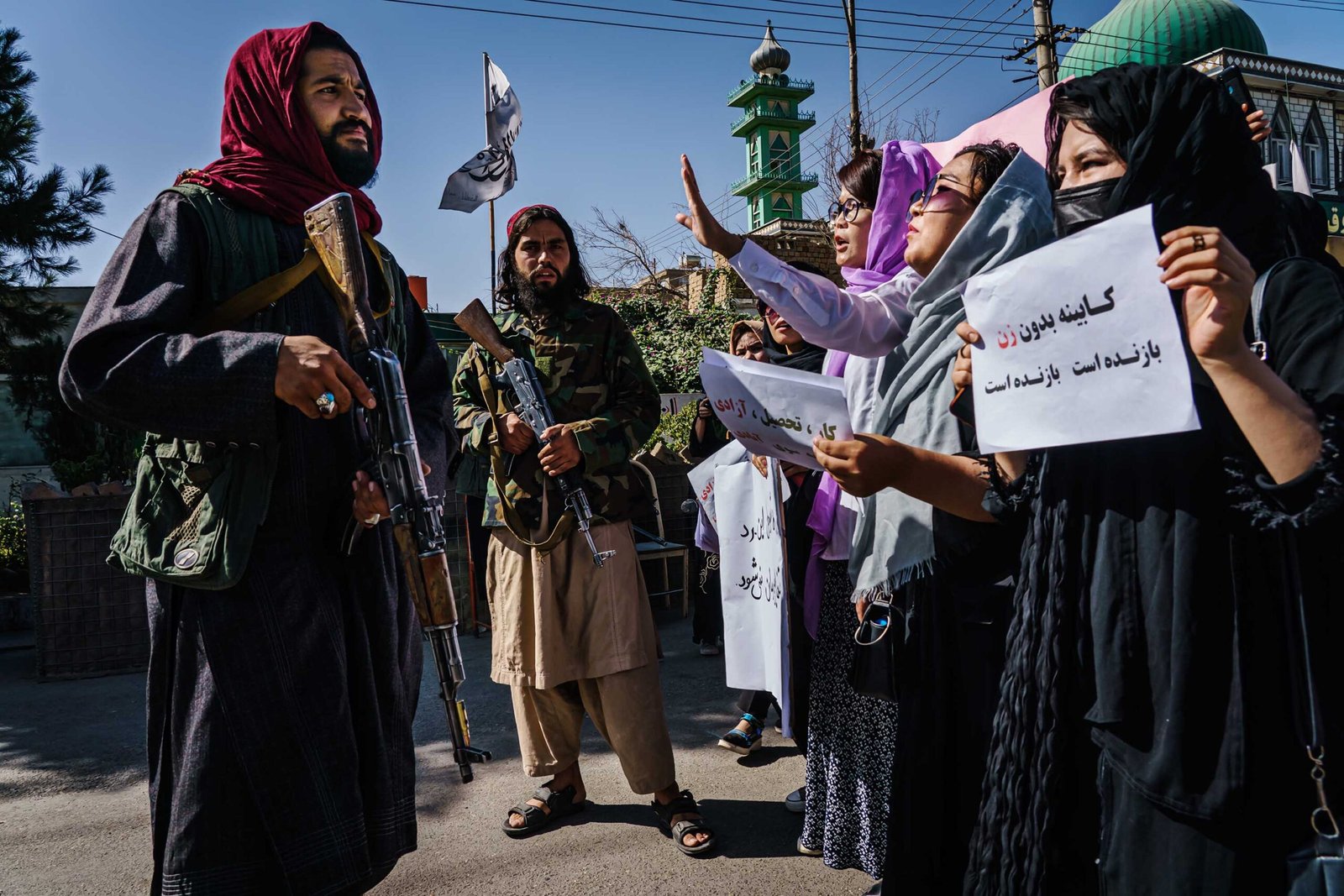
One prominent example involved journalists from the Etilaatroz newspaper who were detained while covering women’s demonstrations in Kabul and subjected to severe physical abuse. Such incidents illustrated the increasingly restrictive environment confronting Afghan journalists after August 2021 (Human Rights Watch, 2021).
UNAMA’s monitoring provides broader evidence of this pattern. Between August 2021 and June 2022, it documented human rights violations affecting 173 journalists and media workers, with the overwhelming majority attributed to the de facto authorities. These violations included arbitrary arrests, detention, ill-treatment, threats, and intimidation (UNAMA, 2022a).
These developments indicate that the Taliban’s return to power substantially reduced the space available for independent journalism and public criticism. Restrictions imposed on media organizations also encouraged self-censorship among journalists concerned about detention or retaliation (Human Rights Watch, 2021).
Women’s Rights and Girls’ Education
The Taliban’s return to power generated particularly serious consequences for women and girls. During the two decades following 2001, women had increased their participation in education, employment, politics, civil society, journalism, and other areas of public life. After August 2021, however, Taliban policies progressively restricted many of these opportunities.
One of the most significant restrictions concerned girls’ education. When secondary schools reopened for boys in September 2021, girls were instructed to remain at home. In March 2022, expectations that secondary schools would reopen for girls were again disappointed when the Taliban authorities suspended education for girls above the sixth grade (UNAMA, 2022b).
By September 2022, the United Nations estimated that more than one million Afghan girls had been prevented from attending secondary school during the previous year (UNAMA, 2022b). These restrictions not only affected individual educational opportunities but also threatened Afghanistan’s long-term social and economic development.
Restrictions were also imposed on women’s participation in employment and public life. UNAMA documented increasing limitations on women’s freedom of movement, employment opportunities, access to education, and participation in society (UNAMA, 2022a). The measures represented a significant reversal of many of the gains achieved by Afghan women during the previous two decades.
The growing restrictions on women and girls also contradicted assurances provided by Taliban representatives during the years preceding their return to power. The contrast between these commitments and subsequent policies became an important source of concern both within Afghanistan and among members of the international community.
International Isolation, Security, and Migration
The Taliban’s return also fundamentally altered Afghanistan’s relations with the international community. The new de facto administration struggled to achieve broad international recognition, while diplomatic engagement remained constrained by concerns over human rights, inclusive governance, terrorism, and the treatment of women and girls.
Security concerns were reinforced by the presence of Al-Qaeda figures in Afghanistan. The killing of Al-Qaeda leader Ayman al-Zawahiri in Kabul in a U.S. strike on July 31, 2022, raised renewed international questions regarding the Taliban’s relationship with Al-Qaeda and Afghanistan’s potential use as a safe haven by transnational terrorist organizations.
The political transformation also contributed to increased displacement and migration pressures. Former government employees, security personnel, journalists, human rights defenders, political figures, and Afghans associated with international organizations were among those seeking to leave the country because of concerns about retaliation and persecution. The deterioration of economic conditions further intensified migration pressures.
These developments demonstrated that the Taliban’s return to power was not simply a domestic political transition. It also had significant implications for regional stability, migration, international security, human rights, and Afghanistan’s relations with the wider international community.
Conclusion
The Taliban’s emergence and return to power cannot be understood independently of Afghanistan’s prolonged political instability, foreign interventions, internal conflicts, and regional power struggles. Emerging in Kandahar during the civil war of the 1990s, the Taliban rapidly expanded its influence by taking advantage of political fragmentation and armed conflict among the Mujahideen factions. Although the movement initially presented itself as a force capable of restoring security and order, its first period of rule between 1996 and 2001 was characterized by severe restrictions on fundamental rights and freedoms, particularly those of women and girls, as well as Afghanistan’s increasing international isolation (Barfield, 2010; Rashid, 2000).
The U.S.-led intervention following the September 11, 2001 attacks removed the Taliban from power but failed to eliminate the movement as a political and military force. During the following two decades, the Taliban reorganized and continued its armed struggle against the Afghan government and international forces (Giustozzi, 2007). The inability to achieve a decisive military outcome eventually contributed to negotiations between the United States and the Taliban. The Doha Agreement of February 29, 2020, and the subsequent withdrawal of international forces created conditions that contributed to the rapid collapse of the Afghan government and the Taliban’s return to Kabul on August 15, 2021.
Developments following the Taliban’s return to power demonstrated a substantial gap between some of the movement’s pre-takeover assurances and its subsequent policies. Despite the announcement of a general amnesty and earlier statements regarding women’s rights and governance, UNAMA documented extrajudicial killings, arbitrary detention, torture and ill-treatment, restrictions on fundamental freedoms, and serious violations affecting journalists, former government officials, women, and girls (UNAMA, 2022a). Restrictions on girls’ secondary education and women’s participation in public life further demonstrated the extent of the transformation following August 2021 (UNAMA, 2022b).
The Taliban’s return to power therefore represents not merely a change of government but a major turning point in Afghanistan’s contemporary political and social history. While the Taliban sought to distinguish its second period of rule from its governance during the 1990s, significant continuities can be identified in its approach to fundamental rights, women’s participation, education, media freedom, and political dissent. Afghanistan’s long-term stability will depend not only on the reduction of armed conflict but also on the protection of fundamental rights and freedoms, inclusive governance, economic stability, and constructive engagement with the international community.
References
Ahmadi, A. (2017). Dinsel şiddetin sosyo-politik kaynakları: Taliban örneği. Uludağ Üniversitesi İlahiyat Fakültesi Dergisi.
Barfield, T. (2010). Afghanistan: A cultural and political history. Princeton University Press.
Dashti, Z. (2021). ABD’nin Afganistan’dan çekilmesi ile Taliban’ın yeniden. Asya Araştırmaları Uluslararası Sosyal Bilimler Dergisi.
Giustozzi, A. (2007). Koran, Kalashnikov, and laptop: The neo-Taliban insurgency in Afghanistan. Columbia University Press.
Human Rights Watch. (2021, October 1). Afghanistan: Taliban severely restrict media.
Karakoç-Dora, Z. (2021). The US-led “War on Terror” in Afghanistan: 2001–2021. MANAS Sosyal Araştırmalar Dergisi.
Kuğu, A. R. (2020). Afganistan’da iktidar mücadelesi ve dış müdahale sorunsalı: Uluslararası toplum için yeni bir yol haritası [Unpublished doctoral dissertation]. İstanbul University, Institute of Social Sciences.
Rashid, A. (2000). Taliban: Militant Islam, oil and fundamentalism in Central Asia. Yale University Press.
United Nations Assistance Mission in Afghanistan. (2022a). Human rights in Afghanistan: 15 August 2021–15 June 2022. United Nations.
United Nations Assistance Mission in Afghanistan. (2022b, September 18). One year of girls being excluded from high school—Renewed call that they be enabled to return to classroom. United Nations.
U.S. Department of State. (2020). Agreement for bringing peace to Afghanistan between the Islamic Emirate of Afghanistan which is not recognized by the United States as a state and is known as the Taliban and the United States of America. U.S. Department of State.
* Department of International Relations, Faculty of Economics and Administrative Sciences, Bolu Abant İzzet Baysal University, akawa208@yahoo.com


